Overview
The proposed Enterprise Exploration and Development Project (the Project) forms part of Beach’s program to explore for and develop offshore natural gas resources in the Victorian Otway Basin. It includes the drilling of two wells (Enterprise East-1 and Selje-1) from the existing onshore Enterprise wellsite to offshore natural gas prospects.
In the event of exploration success, the connection of these wells to the existing wellsite infrastructure will enable gas flow to the Otway Gas Plant via the existing Enterprise pipeline.
This page covers the scope of two Operation Plans for the following activities:
- Well and campsite construction; and
- Onshore drilling.
Civil construction works are required to prepare the site for future drilling activities and to support the safe and efficient management of the project.
Well and campsite civil construction activities may include:
- Site preparation and minor earthworks within the existing well and camp sites
- Establishment of the temporary accommodation camp facilities
- Installation of a lined drilling sump and civil works to construct two well cellars
- Installation of two well conductors using a water bore rig (or the drilling rig depending upon operational requirements)
- Mobilisation of the drilling rig to the wellsite.
- Drilling activities may include:
- Extended reach drilling exploration wells from the Enterprise wellsite
- Well clean up and testing
- Management of equipment, materials and waste
- Demobilisation of the drilling rig and camp and rehabilitation following completion of the drilling operations.
A more detailed description of all activities associated with the Project is provided in the Notice of Operations.
Subject to approvals and a final investment decision, civil construction activities are expected to commence in early to mid-2027, with drilling expected to commence in mid-to late 2027.
The construction activities will occur in daylight hours only, with the drilling rig operating 24-hours a day, seven days a week from the onshore Enterprise wellsite.
Construction activities are expected to take four to six weeks, and drilling operations are expected to take approximately three months per well.
The overall program is expected to take up to nine months, including civil preparation, mobilisation and demobilisation of the rig and well testing activities.
All timings are subject to receipt of all required licences, permits and approvals and the durations may vary depending on geological conditions, weather and operational requirements.
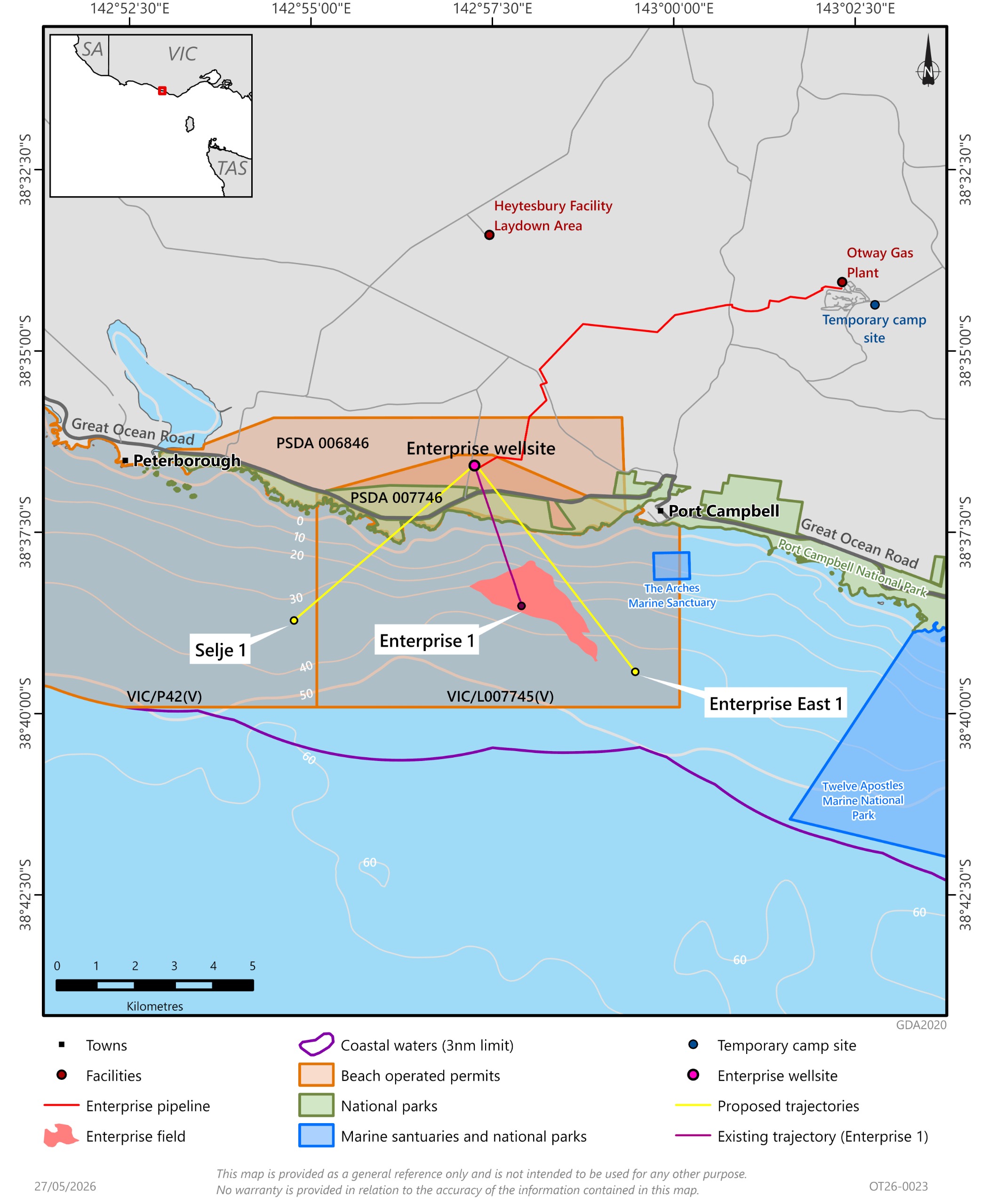
The Enterprise wellsite is located onshore within Beach’s Petroleum Special Drilling Authorities PSDA006848 and PSDA007746, approximately 4 km west of Port Campbell (see map). An approximately 11 km underground pipeline (PL006998) connects the Enterprise wellsite to Beach’s Otway Gas Plant, where gas is processed.
The proposed well site civil construction works, and onshore drilling activities would occur within the existing Enterprise wellsite, located on private farming land. Activities would remain within the existing Enterprise well lease area, with no expansion of the current lease area proposed as part of this activity.
The temporary campsite for the drilling operations would be located at an existing hard stand area adjacent to the Otway Gas Plant.
Activity map
The civil construction activities and onshore drilling activities require the assessment and approval of Operation Plans, which includes related Environmental Management Plans (EMPs), prepared in accordance with the requirements of the Petroleum Act 1998 (Vic) and associated Petroleum Regulations 2021.
In addition, the well site and campsite activities would require consent from the Minister for the Environment to drill through the Port Campbell National Park and planning permits from the Corangamite Shire.
No drilling can commence until all required approvals are in place.
The onshore project area is located within southwest Victoria, adjacent to the Port Campbell National Park and Great Ocean Road. The region experiences a cool temperate climate characterised by cold, wet winters and warm, dry summers. Rainfall is predominantly winter based, and strong westerly to south westerly winds are common, particularly during the passage of winter cold fronts.
The coastal landscape is dominated by limestone geology, forming steep cliffs, wave cut platforms and isolated sandy beaches. These dramatic landforms are a defining feature of the Great Ocean Road and are highly valued for their scenic and tourism importance. Inland from the coast, the landscape transitions to gently undulating agricultural land.
Nearshore and coastal habitats support a range of seabirds and shorebirds, including migratory species protected under the Environment Protection and Biodiversity Conservation Act 1999. Rocky intertidal areas and beaches provide feeding and roosting habitat. Terrestrial vegetation in the broader area includes coastal scrub, grasslands and modified agricultural landscapes. While most native vegetation has been altered by historical land use, remnant patches and roadsides still provide habitat connectivity for birds and small fauna.
The Arches Marine Sanctuary lies immediately offshore and protects ecologically significant limestone reef systems. The coastal zone is part of a highly sensitive landscape due to its ecological, visual and recreational values.
Port Campbell is the primary coastal settlement and serves as a tourism hub for the surrounding region. Land uses in the onshore area include grazing, farming, lifestyle blocks and tourism related developments. The Great Ocean Road is a key economic and cultural asset, attracting significant visitor numbers for sightseeing, walking tracks, surfing, diving and wildlife viewing. Recreational fishing and boating also contribute to local lifestyle and economic values.
The onshore coastal area contains numerous Aboriginal cultural heritage sites, particularly shell middens and artefact scatters associated with long term occupation of the coast. The Eastern Maar people are the recognised traditional owners and hold native title rights along the coast and nearshore zone. European heritage values include historic shipwrecks and associated cultural narratives that underpin the Shipwreck Coast identity.
Beach recognises the environmental, cultural, heritage, social and economic values in our operational and planning areas and has a proud track record of successful safety and environmental performance, adhering to performance measures set out in accepted EMPs and safety cases.
The well and campsite civil construction and onshore drilling activities Operation Plans, including associated EMPs:
- Identify the risks the activities may pose to the environment, any member of the public, land or property in the vicinity of the operation and to any petroleum, source of petroleum or reservoir that the operation may affect.
- Specifies what Beach would do to eliminate or minimise those risks.
- Specifies what Beach would do to rehabilitate any land affected by the activities.
A summary of the potential impacts and risks associated with the proposed activities and the identification of control measures to ensure that these risks and impacts are reduced as far as is reasonably practicable is outlined in the Notice of Operations.
Beach recognises First Nations groups and their spiritual and cultural connection to the environment. Beach has undertaken consultation with the Eastern Maar Aboriginal Corporation (EMAC) representatives since the inception of the Enterprise Project and has undertaken cultural heritage assessments for the Enterprise wellsite and pipeline with EMAC representatives and nominated cultural heritage specialist consultants. In November 2023, a Native Title agreement relating to the Enterprise Project was reached between the Eastern Maar Native Title Holders, the State of Victoria and Beach.
Beach will continue to consult with EMAC, as well as any newly identified First Nations groups, to identify cultural values and sensitivities associated with the proposed activities and to address any potential impacts.
The Otway Emergency Response Plan describes the actions to be undertaken in the event of an emergency associated with the Project activities.
The Emergency Response Plan includes input from a broad range of sources including operational personnel and health and safety representatives and contains communication channels for emergency services. Reviewing and testing of the Emergency Response Plan involves:
- Conducting emergency response drills.
- Testing of associated procedures and systems when they are first devised or significantly changed, and on a regular basis not exceeding six months.
- Undertaking a review of all tests to identify opportunities for improvement and amendment of the Otway Emergency Response Plan.